
AI-Enabled Engineering of Programmable Intracellular Biologics for Next-Generation Cancer Immunotherapy
Primary supervisor: Crispin Hiley, UCL
Secondary supervisor: Charlie McTernan, King’s College London; Francis Crick Institute; Sergio Quezada, UCL
Project
Recent advances in artificial intelligence have transformed our ability to design proteins with high affinity and specificity for intracellular targets, creating new opportunities to develop programmable intracellular biological therapies capable of selectively degrading disease-causing proteins. These bioPROTACs represent an exciting new therapeutic modality with the potential to target proteins that have previously been considered undruggable.
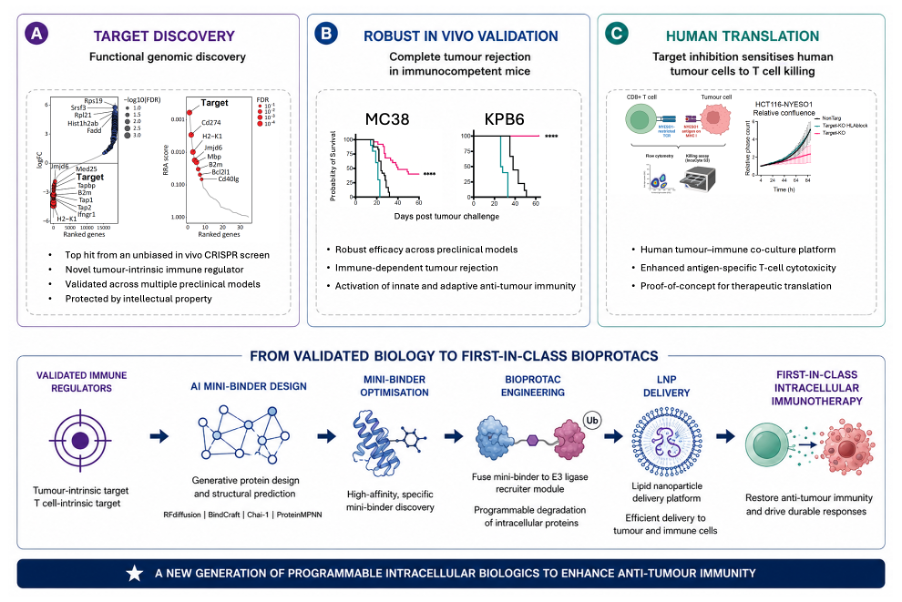
Our laboratories (Dr Crispin Hiley & Prof Sergio Quezada) have recently identified novel, intracellular tumour cell-intrinsic and T cell-intrinsic regulators of anti-tumour immunity through complementary functional genomic screening approaches. These discoveries are protected by intellectual property and provide an exceptional opportunity for therapeutic translation. The tumour cell-intrinsic regulator has been extensively validated across multiple murine and human cancer models, including lung and colorectal cancer, where genetic ablation of this pathway results in profound enhancement of anti-tumour immune responses and durable tumour rejection in vivo. However these intracellular targets are not suitable for traditional therapeutic targeting approaches. Ongoing studies have identified potentially suitable therapeutic modalities including transient modulation with RNA-based approaches. In parallel, we have identified a novel T cell-intrinsic immune regulator that enhances anti-tumour immunity and provides a complementary opportunity for therapeutic intervention. Our data underscores the therapeutic opportunities found in intracellular targets highlighting the need for more efficient and high throughput methods for design and evaluation of therapeutics targeting the ‘undruggable’ intracellular space.
The aim of this PhD is to establish an end-to-end platform for the AI-guided design, engineering and experimental validation of bioPROTAC therapeutics targeting intracellular immune regulators. bioPROTACs are mRNA-based therapeutics that encode a fusion protein: a target-binding domain (a VHH nanobody or an AI-designed mini-binder) joined to a degrader domain that recruits the cell’s protein-degradation machinery, thereby driving destruction of the target protein. The student will learn state-of-the-art computational approaches for protein design and engineering, including generative AI methods for mini-binder design, structural prediction and computational optimisation. Candidate mini-binders will be engineered into bioPROTACs vectors designed to allow for high throughput screen of best binder/degraders. Best candidates will be evaluated for their ability to degrade and enhance tumour immunogenicity and improve anti-tumour immune responses. Importantly, the project will also explore delivery strategies of mRNA-coded bioPROTACs using emerging lipid nanoparticle technologies, establishing a translational pipeline for intracellular biologic therapeutics.
This highly interdisciplinary project brings together internationally recognised expertise in computational protein design, cancer immunology, functional genomics, structural biology and translational therapeutics across University College London, Kings College London, the Francis Crick Institute and collaborating computational biology groups. The successful student will receive training spanning AI-based protein design, protein engineering, lipid nanoparticle design, cancer biology and immunotherapy, while contributing to the development of a new generation of intracellular biologics for cancer treatment.
Candidate background
We are seeking an enthusiastic and highly motivated student with a strong quantitative or experimental background and an interest in applying artificial intelligence to biomedical research. We are seeking applicants willing to learn and work in both the computational/AI and the experimental laboratory research required for this project. Applicants may come from disciplines including computational biology, computer science, bioinformatics, structural biology, molecular biology, or biochemistry. Experience with programming (e.g. Python or R), data analysis, structural biology, protein modelling or machine learning would be advantageous, although not essential, as full training will be provided. Equally, candidates with a strong experimental background in molecular biology, cancer biology or immunology who are keen to develop computational skills are highly encouraged to apply. The successful student should be intellectually curious, enjoy interdisciplinary research and be excited by the opportunity to work at the interface of AI, protein design/engineering, laboratory-based experimentation and cancer immunotherapy. Excellent communication skills, creativity and a collaborative approach will be important, as the project involves close interaction with researchers across UCL, KCL and the Francis Crick Institute.
Potential Research Placements
- Franca Fraternalli, Structural & Molecular Biology, UCL
- Sergio Quezada, Cancer Institute, UCL
- Charlie McTernan, Kings College London and Francis Crick Insitute
References
- Chan, A., Haley, R.M., Najar, M.A. et al. Lipid-mediated intracellular delivery of recombinant bioPROTACs for the rapid degradation of undruggable proteins. Nat Commun 15, 5808 (2024)
- Pacesa, M., Nickel, L., Schellhaas, C. et al. One-shot design of functional protein binders with BindCraft. Nature 646, 483–492 (2025)
- Yuan, X., Xiao, Y. & Yu, D. Turn cold tumors hot by reprogramming the tumor microenvironment. Nat Biotechnol 43, 466–470 (2025)