
AI-guided discovery of early cancer-associated epigenetic cell states from single-cell DNA methylation
Primary supervisor: Tommy Kaplan, Queen Mary University of London
Secondary supervisor: Simone Zaccaria, UCL
Project
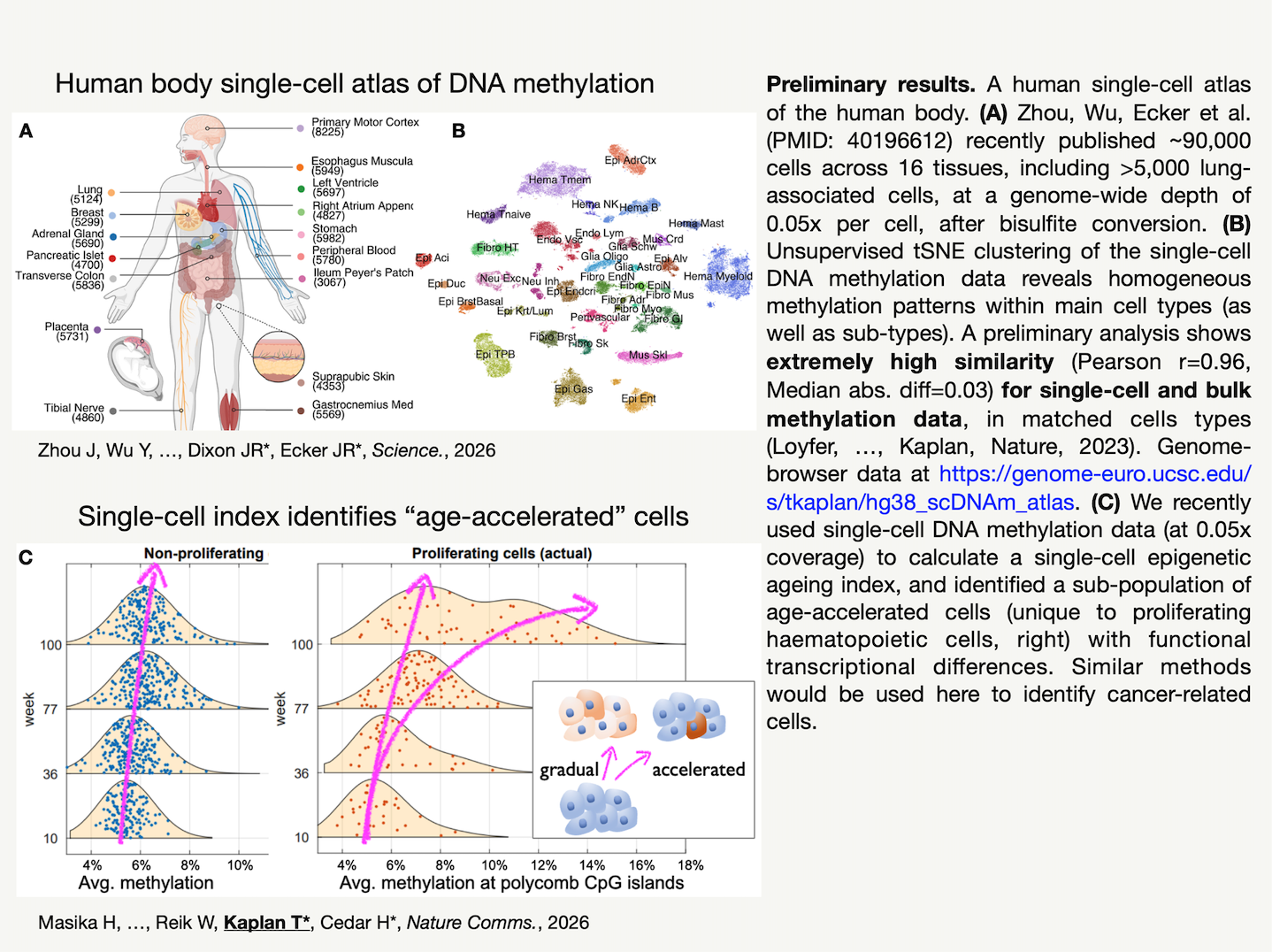
The Kaplan lab (Barts Cancer Institute) recently published the most comprehensive DNA methylation atlas of the human body (Loyfer et al, Nature, 2023), translated it into cell-free DNA and ctDNA liquid-biopsy assays, and studied epigenetic ageing in cells using DNA methylation and gene expression (Masika, Nature Comms., 2026). The Zaccaria lab (UCL Cancer Institute) develops methods for sparse single-cell cancer genomics, including CHISEL, SPRINTER, and SCARLET, and co-led recent TRACERx studies in lung cancer evolution (Zaccaria, Nature Biotech., 2021; Lucas, Nature Genetics, 2025; Hessey, Nature, 2026).
This project combines AI, epigenomics and cancer evolution to study how cancer begins in normal cells, often years before diagnosis. We and others have shown that cancers evolve through complex sub-clonal populations (Lucas, Nature Genetics, 2025). Yet the earliest steps of transformation in normal and premalignant tissue remain largely invisible. This PhD aims to make them visible using the emerging technology of single-cell DNA methylation.
We have recently shown that in healthy tissues, methylation is a stable cell-type-specific record of identity, highly conserved across individuals (Loyfer, Nature, 2023; Rosenski, Nature Comms., 2025; Rosenski, Nature Comms., 2026). In cancer, somatic mutations and methylation changes accumulate throughout neoplastic transformation. But conventional methylation studies average signals across thousands of cells and cannot tell whether early changes accumulate gradually in every cell or arise together in rare abnormal subpopulations.
Single-cell DNA methylation (scDNAm) data can answer this: a recent atlas profiled ~90,000 cells across 16 tissues, including >5,000 lung-associated cells (Zhou, Ecker et al, Science, 2026, PMID:40196612), and new single-cell methylation atlases published almost monthly (e.g. Jeong, Nature Aging, 2026, PMID:41648348). Yet each cell is only sequenced at ~0.05x, compared with 1-80x for conventional methylomes, so most CpGs are never observed in any given cell. Analysing such sparse data requires machine learning and AI, and we have the expertise to do so.
The student will develop computational methods to infer each cell’s identity and state from partial observations, detect rare cell populations with cancer-associated patterns, and retrospectively pool them to reconstruct genome-wide methylomes. We will then identify novel differentially methylated regions (DMRs) for clinical uses.
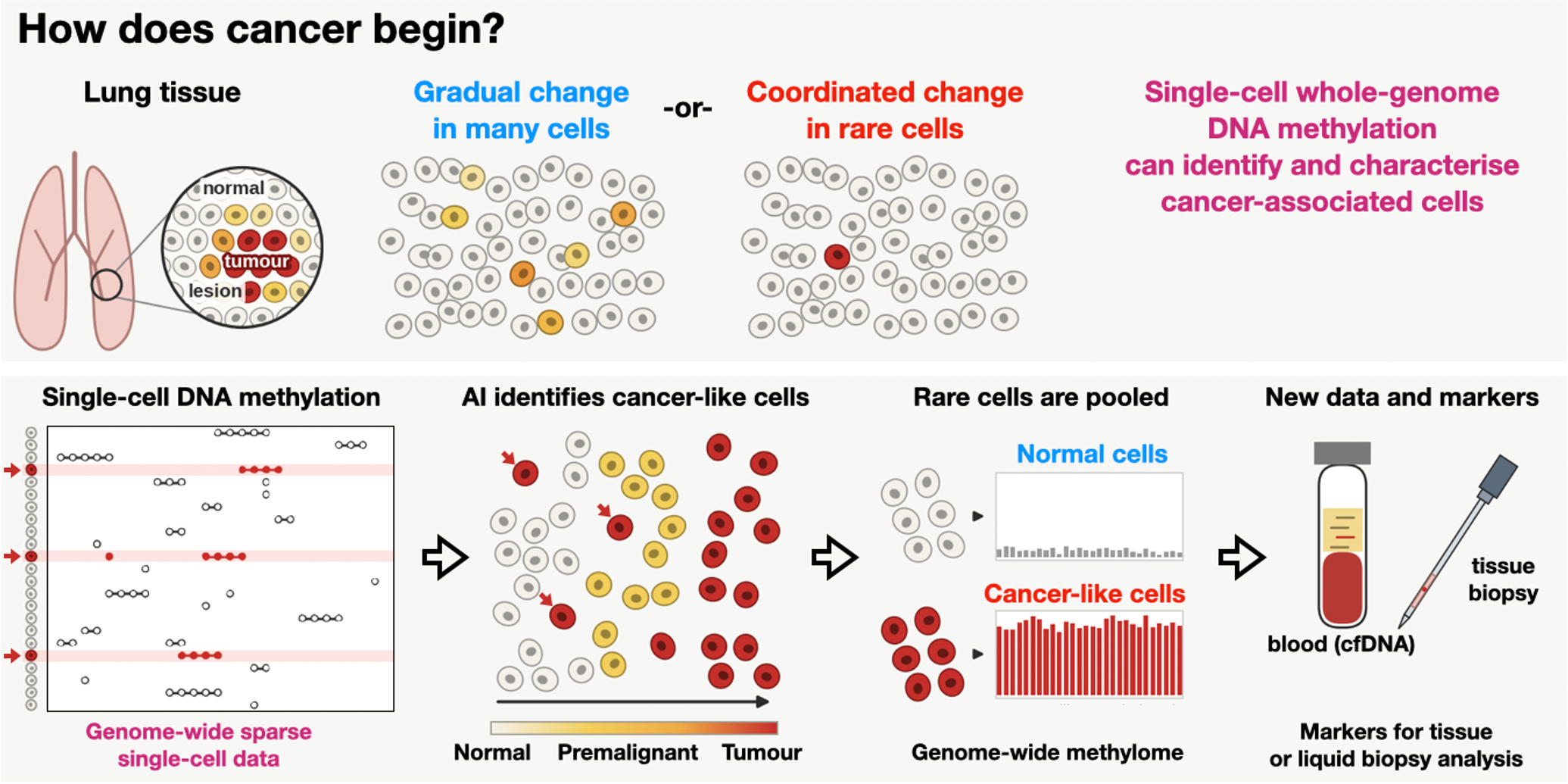
Bulk methylation data for normal lung, premalignant lesions and tumours will support these models, while multi-modal AI will link methylation to single-cell RNA-seq data and chart this transformation functionally, through loss of identity, plasticity and proliferation. Starting with lung adenocarcinoma, we will ask when and where cancer-associated epigenetic changes emerge, whether they mark rare cells on the path towards malignancy, and whether their signatures can be detected in blood.
- Years 1-2: map normal and transforming states: assemble published bulk/single-cell data; derive cell-type markers and changes from normal lung through premalignancy to tumour; develop AI models to identify cell populations.
- Years 2-3: find cancer-like cells: detect cells carrying these changes within normal and premalignant tissue, test whether they accumulate sequentially or arise independently, and reconstruct genome-wide methylomes.
- Years 3-4: evolution and translation: relate epigenetic states to copy-number evolution in tumour scDNAm data, test candidate signatures in cell-free DNA, write thesis.
Candidate background
We seek a quantitative candidate with a degree in computer science, mathematics, statistics, physics, bioinformatics or computational biology, strong programming and algorithmic skills, and curiosity about cancer biology. The student will gain rare dual training in ML/AI and cancer biology across two leading institutes.
Potential placements
- Nitzan Rosenfeld, Barts Cancer Institute, Queen Mary University of London
- Nnenna Kanu, Cancer Institute, UCL
- Mirjana Efremova, Barts Cancer Institute, Queen Mary University of London
Reference
- Loyfer N, Magenheim J, Peretz A, … Dor Y, Glaser B, and Kaplan T. A DNA methylation atlas of normal human cell types. Nature (2023). PMID 36599988 (https://www.nature.com/articles/s41586-022-05580-6)
- Masika H, … Dor Y, Reik W, Kaplan T, and Cedar H. Cell-to-cell variability and gain of methylation at polycomb CpG islands as a hallmark of aging. Nature Communications (2026). PMID 42265112 (https://www.nature.com/articles/s41467-026-74118-5)
- Zaccaria S and Raphael BJ. Characterizing allele-and haplotype-specific copy numbers in single cells with CHISEL. Nature biotech. (2021). PMID 32879467 (https://www.nature.com/articles/s41587-020-0661-6)
- Lucas O, … Kanu N, Swanton C, and Zaccaria S. Characterizing the evolutionary dynamics of cancer proliferation in single-cell clones with SPRINTER. Nature Genetics (2025). PMID 39614124 (https://www.nature.com/articles/s41588-024-01989-z)
- Rosenski J, Sabag O, … Cedar H, and Kaplan T The genetic basis for DNA methylation variation across tissues and development Nature Communications (2026). PMID 41980926 (https://www.nature.com/articles/s41467-026-71693-5)